ON THE MOVE · LANDSCAPES
The journey outside the train window
Between the famous places, another China appears: fields, hills, bays and the edges of cities.
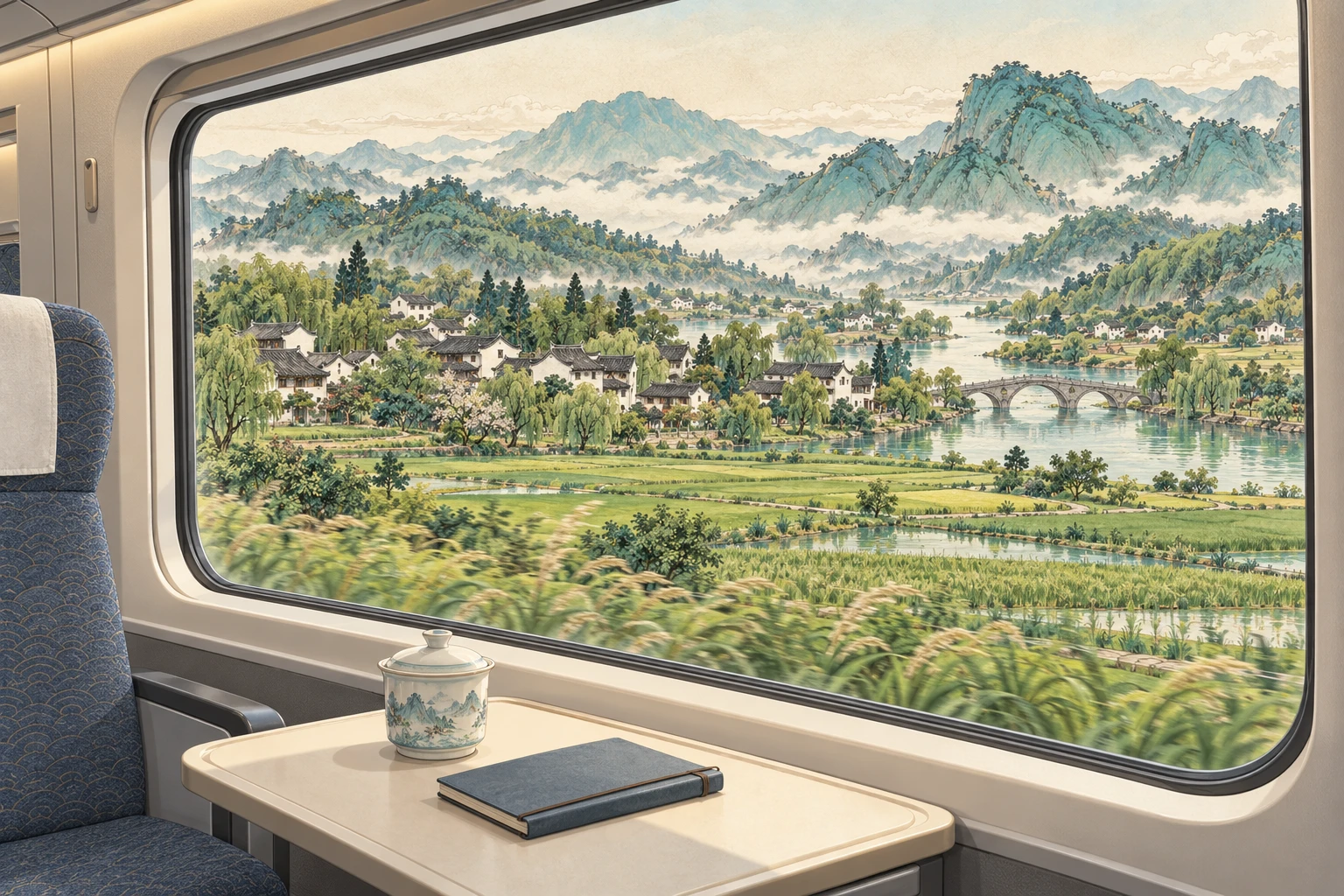
Look between the destinations
A rail journey connects the places on an itinerary, but the space between them can become part of the trip too. Depending on the route, the window may show fields, apartment blocks, waterways, hills or industrial land. None of those scenes alone explains the country. Together, they can loosen the idea that a trip consists only of famous landmarks. Watch for transitions: where buildings thin out, how a river changes the shape of a settlement, or how quickly a distant ridge appears to move compared with something close to the track.
East China: a landscape with several layers
The Hangzhou–Huangshan railway links cities in Zhejiang and Anhui, passing through places including Jiande, Chun'an, Jixi and Shexian. The route provides a geographical thread through a region known for waterways, hills and historic settlements. Those place names can make a map more interesting before you travel: look at where your train is going rather than imagining a blank line between two cities. Huangshan is both the name of a city and a mountain destination; arriving at a railway station is not the same as arriving on a mountain trail. Let the journey introduce the region gradually.
Fujian: a brief meeting with the sea
The Fuzhou–Xiamen high-speed railway crosses Meizhou Bay, Quanzhou Bay and Anhai Bay on major bridges. It offers a different relationship between railway and landscape: for part of the trip, the view opens over coastal water. The crossings are moments within a journey, rather than a continuous sea view. Weather, daylight and the exact service matter to what you see. That makes attention more useful than waiting for a single promised photograph. When the scene opens, look at the water, the shore and the scale of the bridge together, then enjoy the next change.
Make a small window ritual
If the scenery interests you, choose a daytime journey when it suits your plans and keep a little of it free of screens. Save the names of three places along the route before boarding. As you travel, connect what you can see with where you are, without trying to identify every village. A notebook can be more satisfying than a blurred photograph: write down one colour, one shape and one question. For booking, station procedures and the practical side of the ride, use the transport guide. Here, the invitation is simply to include the journey in your attention.